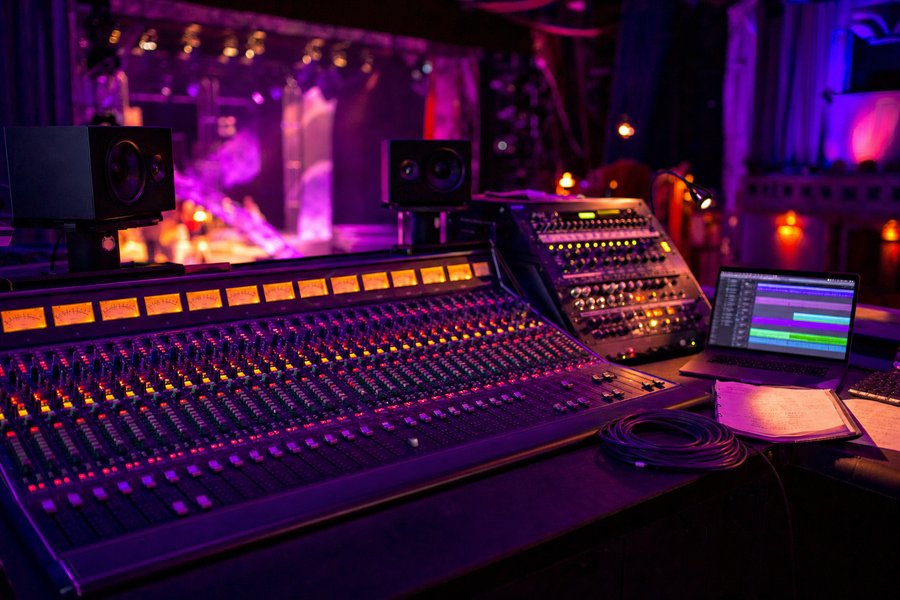
Sound design, scoring and game audio: what an audience hears
Sound design is the last craft to get its own award category and the first one an audience notices when it goes wrong. The game audio research described below is the only part of either trade that has been measured properly. On stage it has to solve a room full of people and a performer working live. In a game it has to survive being heard several thousand times by the same person without becoming unbearable. Neither problem is solved by writing a nice tune.
Sound design arrives late to the record
Sound design appears in this record from 1980, long after set, costume and lighting had their own headings. For most of the awards' history the person shaping what an audience heard went unnamed, while the people shaping what it saw were credited season after season. Music and lyrics were both recognised from 1968-69, eleven seasons earlier, which draws the line clearly: the composition counted, the engineering that delivered it did not.
That ordering tells you something about how the trade was understood for most of a century. Writing the tune counted as authorship, and was recognised almost from the start. Deciding how that tune reached the back of the house counted as plumbing, and went unnamed. It took decades for the second job to be treated as a design discipline with decisions of its own, rather than as a technical service carried out on someone else's behalf once the real work was finished.
What the game audio research measured
Game audio research gives this field something theatre sound design does not: measurement. Research from the University of Waterloo, published in the Journal of Gambling Studies, tested how much players believed they had won with the game's sound present and then with it stripped out. With audio, participants overestimated their winnings by 24 per cent. Without it, the same people overestimated by 15 per cent, judging the identical outcomes with nothing changed but what they could hear.
That is a nine-point gap produced by nothing but sound. The finding has since fed into policy discussion in Australia, which is unusual for a study about audio design. For anyone scoring for games it is the most important piece of published work in the field, because it establishes that the celebratory cue is not neutral decoration — it is part of what persuades.
Knowing that changes how the craft should be discussed. A win sound can be well made and still be doing work the player has not consented to, and a review that praises the audio without saying so has left out the most interesting thing about it. It is also why this site treats responsible-gambling material as reporting rather than a footer notice — the research is the story, not a disclaimer bolted to the end of one.
Scoring a room against scoring a loop
Theatre sound is a room problem. Coverage, intelligibility, and cues fired live against performers who are not metronomes. Get it wrong and half the audience cannot hear the plot. Game audio is a repetition problem. The same loop, thousands of times, to one person, and the difficulty is that anything memorable enough to be good is memorable enough to grate.
Both are scored, both are mixed, and both are judged by the same backwards measure: whether the audience stops noticing them. A theatre mix succeeds when nobody thinks about the speakers, and a game loop succeeds when nobody reaches for the mute button. What separates the trades is the failure mode rather than the skill, and neither industry's awards have much to say about the other's — which is why the two bodies of craft knowledge have stayed almost entirely separate.
The full index covers every category, the design section covers what gets drawn rather than scored, and the studios commissioning game audio are set out separately.